Tuesday, July 17, 2012

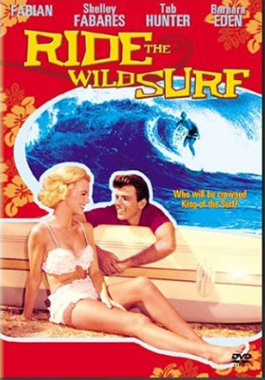
Ride the Wild Surf Movie Review

I like to think that in some other life I was a surfer dude. Though considering that I typically swim like a brick, this isn’t likely. I found out about an old surfing movie called Ride the Wild Surf (1964) while doing some internet surfing of my own. The way it was depicted on this website made it sound worth my time. Turns out it was, but not because it was a good movie.
Having recently graduated from high school, three friends take one last trip together before going their separate ways in life. Jody Wallis (Fabian), Steamer Lane (Tab Hunter) and Chase Colton (Peter Brown) take to Hawaii’s Oahu Island to ride the world’s biggest waves, a long standing dream they’ve shared. Naturally, each one finds a romantic interest to pursue. Steamer falls in love with Lily (Susan Hart), whose mother objects since her husband—also a surfer—left home and family to follow a surf circuit. Jody, the self-described college dropout and surf bum, falls for the reserved Brie (Shelley Fabares) who challenges him to return to college. Straight-laced Chase finds himself repeatedly drawn to adventurous Augie (Barbara Eden). A surfing competition is being held and despite conflicts, injuries, and rocky romances, the three young men compete against ruthless competition to prove themselves a top surfer.
Ride the Wild Surf is just about as cliché as can be. The characters are all very simple and shallow. The story about young people falling deeply love over a weekend and talking about life together is unrealistic and corny. The whole sporting event to prove something to yourself or others is overdone. The cinematography wasn’t always good, the use of a blue screen was blatantly obvious as the actors moved in different directions than the background.
Even the acting was pretty bland. If not for a few exceptions like Barbara Eden, Tab Hunter, and Susan Hart, it would have almost been unwatchable. They bring some life and expressiveness to the otherwise lackluster acting in this movie. You may recognize Barbara Eden who also starred in the I Dream of Jeannie sitcom back in the day. I suspect she is somehow immune to aging, she still looks young and energetic in every other role I’ve seen her in.
Fabian was kind of an Elvis Presley byproduct. Like Elvis often did in his movies, Fabian plays a character with a giant chip on his shoulder, ready to beat the crap out of anyone who would dare accuse him of being a coward. This happened in so many Elvis movies it became a joke. It plays out in much the same dramatically illogical way here; resulting in Fabian's character being irritating throughout.
To its credit, Ride the Wild Surf was filmed on location in Hawaii. Most Hollywood beach movies are filmed in Southern California. The movie really captivates the sport and the culture surrounding it. The surfing jargon and concerns over the dangers sound reasonably authentic. In 1963, weather conditions were such that huge waves were made on the Hawaiian shores. The producers took advantage of this and got some outstanding shots of some truly epic waves. I understand this movie is supposed to have some of the best surf photography of any non-documentary surf film. I don’t know if that’s true, but I certainly was impressed by the waves they captured on film.
So, why watch Ride the Wild Surf? Well, it was interesting to see how “teen movies” and culture in general have changed over the years, or remained the same. Everyone was very trusting of total strangers back then, now we tend to assume strangers have an ulterior motive when we are approached. Steamer follows Lily to her ranch to get to know her better. Rather than having the cops called on him, he is invited to dinner. The way people spoke to one another in this movie surely sounded natural in its day, but it sounds quaint now. For example, in one scene a rival surfer’s nose is accidentally broken by Jody. Our protagonist sincerely apologizes, but the best threat the rival is able to come up with is saying that “maybe I can return the favor someday,” causing anyone who overheard it to look stunned by his brashness. In a contemporary movie we’d expect to hear an articulate death threat that would give the audience a reason to worry about the protagonist’s safety. Ride the Wild Surf seems hilariously tame by today’s standards, and that contract makes it amusing to watch.
Ride the Wild Surf was just about as cheesy a movie as you could ask for from the 1960’s. Granted, it is better than most of the equally low-budget horror movies of its day. The script is lousy, the surfing is phony, and the boy-girl scenes lack chemistry. Anyone over the age of twelve would be disappointed with most aspects of this film. You’ll be just fine if you never see it, but it’s a fun, light-hearted, campy romp of a surf movie that would be good for a “lost in the 60’s” themed party or to see how the “teen movie” genre has changed over the decades.

Have you seen a movie that captured some truly impressive surf photography? What was it? Did you like it? Comment below and let me know!

Friday, July 13, 2012

Brother Bear Movie Review

Disney produces a new animated feature just about every year.  Many of these become cinema classics that withstand the test of time. Beauty and the Beast, for example, is still a well known classic that you can still find merchandise for decades after its initial 1991 release. Brother Bear (2003) was released only about ten years ago, and it’s been about ten years since I heard anyone talk about it.
Set in a post-ice age North America, three Inuit brothers return from a hunting trip. The youngest, Kenai (Joaquin Phoenix), is to receive his sacred totem which will make him a man in the eyes of his tribe. In the ceremony Kenai receives the bear of love to guide him through his life. Kenai hates bears and considers the attribute of love to be pretty far down the totem pole, so to speak. Kenai finds his fishing catch stolen by a bear after the ceremony and decides to hunt down the beast. While attempting to save his brother from the bear, the oldest brother, Sitka (D.B. Swenney), is killed. With a renewed sense of vengeance, Kenai later kills the bear. Following this, Sitka appear as an eagle spirit and transforms Kenai into a bear. The middle brother, Danahi (Jason Raize), believes that bear-Kenai is responsible for the death of both his brothers and begins hunting down Kenai out of a strong sense of hate. As he tries to seek the spirits who can restore him to his human form, Kenai tries to stay ahead of Danahi while learning how to be a bear from a young bear cub named Kota (Jeremy Suarez).
Possibly the best thing I can say about Brother Bear is the animation and art direction is impressive. The art direction was heavily influenced by ancient cave paintings. The film’s aspect ratio was used as a storytelling device. It begins in a standard widescreen aspect ratio of 1.75:1, which is common in U.S. movies and on HDTVs these days. After Kenai turns into a bear, the aspect ratio changes to an anamorphic aspect ratio of 2.35:1, accompanied by a much brighter and fanciful color pallet with slightly more caricatured art direction. This is done to illustrate how Kenai’s perception of the world changes and broadens.
During the character introductions early in the film, the script seemed forced; everyone goes out of their way to address other characters by name so that we know exactly what everyone’s name is. We’re also repeatedly told about Kenai’s desire to receive his spirit totem and become a man. The writing wasn’t very good for the first ten minutes of the movie because it didn’t feel very natural. After the characters were established, the script flowed much smoother.
Of course where would an animated Disney movie be without its token comic relief characters? In Brother Bear there is a pair of moose named Rutt and Tuke that periodically tag along with Kenai and Kota as they travel. They are played by Rick Moranis and Dave Thomas and are essentially the same characters they played in Strange Brew, except they look like moose. They really add a humorous tone to the movie.
Remembering that Brother Bear came out in the years following the 9/11 attacks sheds some light on its cultural impact. After September 11, 2001 the United State was still reeling from the terrorist attack which was fueled by hatred and anger. Many people were resentful, angry, hurt, and some were even vengeful. I think we needed a film like Brother Bear to remind us of the value of forgiveness and love. The themes in Brother Bear included seeing things from another’s perspective, admitting fault, and forgiving hurtful, irreversible offenses. These are key components to conflict resolution that are important in the healing process. Disney isn’t responsible for the US recovering from the attack, but I think they may have influenced some level of spiritual healing that I believe many people were still needing.
I think that what made Brother Bear not withstand the test of time is that is wasn’t very bold. The Disney films that have achieved the status of “classic” did things in terms of character, setting, and animation that their predecessors did not. Brother Bear was good, but seemed to strive to be sweet and cute rather than bold and exciting. And it really did achieve that, which is why it’s been overshadowed by bolder and more exciting classics like The Lion King or Finding Nemo. Brother Bear is worth seeing at least once. Kids will enjoy it and adults will relate to the spiritual healing in the story. It’s also got plenty of material to help you teach younger viewers about forgiveness, love, and healing.

Have you ever seen a movie that helped you “heal” in some way? What movie was it? Comment below and tell me about it!

Tuesday, July 10, 2012

Batman Begins Movie Review

Batman movies have had a longstanding tradition of being totally silly. From the 1966 Batman movie with its “Shark Repellant” to Batman and Robin that attempts to be family friendly and silly. While making a family friendly movie isn’t bad, making a family friendly Batman movie is something like trying to make a family friendly version of The Godfather. You’re just going to besmirch the pervasive dark themes and complex characters. Fortunately, Christopher Nolan finally brought us the type of Batman story we’ve been expecting for decades with Batman Begins (2005).
Millionaire playboy Bruce Wayne (Christian Bale) still grieves the loss of his philanthropic parents to a senseless crime. While traveling the world to research the nature of evil, he is discovered by Henri Ducard (Liam Neeson) and Ra’s Al Ghul (Ken Watanabe) in China taking on petty thieves in a prison. They train Bruce how to fight evil and strike fear into the hearts of his enemies as a symbol rather than as a man. After Bruce learns of their plot to wipe out evil in his home city of Gotham, Bruce attempts to stop them and returns home. Back in his original surroundings, Bruce adopts the image of a bat to strike fear into criminals as the icon known as “Batman.” Things don’t stay quiet for long as the corrupt psychologist Dr. Jonathan Crane (Cillian Murphy) works to pollute the water supply with a panic-inducing psychoactive drug that will cause the citizens of Gotham to tear themselves apart out of fear.
I admit to being a much bigger fan of the Marvel superheroes. Batman is probably the only DC hero I really like. Batman is one of DC Comic’s most legendary superheroes, second only to Superman. Tim Burton’s two Batman movies were good, but Batman Begins shows us Batman finally getting the treatment and respect he deserves. This is one of the greatest revamps given to a cultural icon.
Comic books that made it to the big screen have for a long while been rather silly romps of action and gratuitous special effects. Some of these movies are fun, but a bit hard to take very seriously. Batman Begins goes in a drastically different direction than its forbears. Everything is significantly more grounded; there are no crazy, over the top super powers or sci-fi gadgetry in this movie. There are fictional, but believable, hallucinogenic drugs. There is also an almost forgotten scientific genius at Wayne Corp. named Lucius Fox (Morgan Freeman) in research and development. He supplies Bruce with high-end military grade prototype gadgets that never went into production because they were not cost efficient. Coupled with Bruce’s ninja-like training, he is able to do some incredible stunts without pushing credibility over the edge.
All the other Batman movies have addressed why Bruce Wayne identifies with bats (childhood trauma) and hates evildoers (he witnessed his parents being killed by a mugger). We are so familiar with that aspect of Batman it almost seems cliché and redundant to reiterate it in another movie. Yet in Batman Begins these are major plot devices and are given significant weight and depth. It’s also fascinating to see how Bruce develops as a character and invents Batman as he goes along. He’s a bit of a slow learner, making clumsy mistakes and taking foolish risks as he starts out. Even after he has an established the “Batman” persona and disguise he still needs to call upon the aid of his family butler, Alfred (Michael Caine), to get him out of a bind.
Batman Begins is an amazingly good superhero movie. It doesn’t have the silly, flashy gloss of earlier films. Everything feels more grounded and believable than the average superhero movie. The characters are complex and interesting. The story is deep and meaningful. The imagery gets pretty intense, so I wouldn’t recommend showing it to younger viewers. There really isn’t anything negative I can say about this. It has become an instant classic, and it will be a long time before we accept a non-Christopher Nolan Batman. This one is definitely worth owning on Blu-Ray. I highly recommend seeing this if you haven’t already, and if you have, I would highly recommend seeing it again.

What’s your favorite non-Christopher Nolan Batman movie to date? Comment below and tell me why!

Friday, July 6, 2012

Inkheart Movie Review

There are several movies that glorify the power of reading. Some of these movies do a good job of praising books and the power of reading. I think that is what Iain Softley was trying to achieve in the 2008 movie, Inkheart, but it didn’t really make me want to race off to the library once it was over.
Mortimer “Mo” Folchart (Brendan Fraser) discovers he has a rare ability to liberate fictional characters into the real world when he reads books aloud. He discovers this power as he reads to his young family one evening. The catch to this ability is that people from the real world become trapped in the book in place of missing characters. When he accidently freed the villain named Capricorn (Andy Serkis) from a fantasy book entitled “Inkheart,” Mo’s wife became trapped in the book. Twelve years later, Mo travels around with his daughter, Meggie (Eliza Bennett), still searching for another copy of Inkheart so that he can read his wife out again. Meanwhile, Capricorn has become a powerful figure in the real world. Knowing Mo’s ability, Capricorn has one of his henchmen, Dustfinger (Paul Bettany), hunting down Mo. Capricorn seeks to take over the real world by letting loose an evil entity called The Shadow, and needs Mo to release it from the book.
As a bibliophile, I appreciate movies and stories that celebrate reading and the power of books. All of the characters in Inkheart have a profound love and respect for books. One of my favorite scenes has Mo browsing the shelves of a used bookstore looking for a copy of Inkheart and hears faint chatter of fictional characters calling to him. This is just about the only moment in the movie that really makes books seem magical. The ideas of reality and fiction have already been explored better elsewhere. The Neverending Story comes to mind. Inkheart starts off well, but quickly degenerates into a basic good guy versus bad guy story with little to set it apart from other movies of its kind.
The biggest problem with Inkheart was that it was confusing. Do all copies of a book change when a character is removed from it? Probably so; Mo is looking for another copy of Inkheart to free his wife. Does a story change drastically if its major characters are missing? Can the same character be “read out” from different parts of a book? It’s hard to say since this isn’t developed in the movie, and there never seems to be consequences for taking a character from a book. Granted, this is a movie targeted towards children who probably wouldn’t grasp such consequences, but that’s not an excuse for sloppy writing.
Brendan Fraser acts very subdued and bored in this role. Andy Serkis is a better actor than the character he portrays here deserves. Yet Paul Bettany does an amazing job! His portrayal of Dustfinger is full of complex subtleties that bring the character to life. You really get a feel for this character and his motives. Dustfinger doesn’t want to keep working for Capricorn, and simply wants to get Mo to return him to his book so he can be with his beloved wife again. We’re not quite sure where his loyalties lie as it seems to change depending on the situation as he tries to advance his personal quest to return to his family. It’s also the only Paul Bettany film I’ve seen to date where he isn’t butt naked on camera.
Inkheart is creative, but seems to lack heart. In one scene, Mo and company are attempting to flee Capricorn’s castle and conjures up the twister from The Wizard of Oz by reading a passage. There’s a chase scene amidst strong winds and debris which concludes when Dorothy’s house lands in the road, blocking the bad guys. It was kind of a neat scene, but doesn’t feel meaningful. Conjuring a twister wasn’t necessary; any kind of distraction would have sufficed. It’s as if the next step in the story simply required that “they escape,” and the twister acted as nothing more than a convoluted, contrived, and convenient means of doing so that allowed them to showcase some special effects.
Inkheart wasn’t that great. It was fun if you don’t try to follow the story, and therefore a perfect movie to watch with young kids. It does a pretty poor job of convincing viewers to pick up a book and read, though you may want to do so anyway to figure out what was happening in the movie. In the end, Inkheart is an “okay” family film, but probably not worth owning a copy of unless your kids somehow fall head over heels in love with it.

If you could bring any character out of a book, who would it be and why? Comment below and let me know!

Tuesday, July 3, 2012

Coyote Ugly Movie Review

I am of the opinion that movies categorized as “romantic comedy” have to add the “comedy” modifier to them to ensure that people will see the movie. While I do enjoy a genuinely romantic story, most romance movies are so sappy and melodramatic they are nearly unwatchable. But as far as romantic comedies go, Coyote Ugly (2000) wasn’t half bad.
An aspiring 20-something songwriter named Violet Sanford (Piper Perabo) moves to New York City with dreams of making it big. Her father (John Goodman) begrudgingly lets her go, fearing for her safety. Working with the music industry proves much more difficult than Violet realized. Needing to support herself until stardom rolls around, Violet gets a “day” job as a barmaid at a nightclub called Coyote Ugly. Coyote Ugly is the city’s newest hot spot where the owner Lil (Maria Bello) and the employees are a team of sexy, resourceful women that dance on the bar, flirt with the mostly male clientele, sing along with the jukebox, and goad the customers into matching them shot for shot.
How many movies have there been about someone from a small town going to the big city with dreams of success and stardom? I’ll bet you can think of at least three off the top of your head without much effort. On top of that, there are countless other movies where a poor young lady is being crushed by the weight of the world only to have an absurdly perfect young man sweep her off her feet and help her with her troubles. What, then does Coyote Ugly have to offer that the others haven’t? Sexy women dancing on a bar top in  a wet T-shirt contest is about all I can think of. Nevertheless, Coyote Ugly fleshes out these clichés enthusiastically without much irony. For that, I have to praise it.
Music played a strong role in this movie. There is lots of raucous and fun music played at the bar, such as "I Will Survive" by Gloria Gaynor, "I Love Rock N Roll" by Joan Jett, and "Rock This Town" by Stray Cats. Coyote Ugly’s soundtrack features Violet's four songs from the movie, performed by LeAnn Rimes, who also did Violet's singing voice. It achieved gold status within a month of its release. The music was fantastic and  really helped set the tone of the bar and the movie.
The bar is almost a character unto itself. It serves as an escape from the world of dead dreams and is a place to live out fantasies while getting mistreated just a little bit. It’s sort of a southern biker bar meets a downtown hot spot full of frat kids. I’ve been to circuses that were more subdued than the Coyote Ugly bar. The movie is about Violet and the atmosphere of the bar. Coyote Ugly has a relationship with all the characters that we see throughout the film; it’s a place for the characters to congregate and interact. A lot of major plot points and character developments are portrayed through the bar.
There was so much texture and detail in the sets. It seemed like an artistic arrangement while still looking like natural backgrounds; that is a very difficult balance to achieve. I was also impressed by the eye-catching color palette. There were some remarkably vivid reds that really popped out with complementary contrasts of darker blues. Most of the camera work was uninspiring, but the striking colors and sets made up for it.
Coyote Ugly is essentially a bartending movie. It’s sexy, raunchy, and very worldly. It was uncomfortable to watch at times since it objectifies women as unattainable sex toys. The movie pushed its limits without actually achieving an R rating. It’s not something I’d recommend watching with your mother present, or young viewers for that matter. The Comedy aspect was respectable. I laughed fairly consistently throughout the film. All in all, Coyote Ugly was not a terrible film. It’s about as slick and mindless as you’d expect from a clichéd risqué movie about making it in the Big Apple while working at a bar. You’ll either like it as a silly, sexy romp of a film that is not to be taken too seriously, or hate it for being similar to so many other movies that have come before it in terms of character and story. It may be worth renting if the risqué content doesn’t put you off too much, otherwise don’t bother.

I can’t think of any other “bartending” movies other than Coyote Ugly, can you? Comment below and tell me if I’m missing anything worth seeing.

Friday, June 29, 2012

Brave Movie Review

Pixar has been around long enough for everyone to have a favorite Pixar movie. And why shouldn’t we? Pixar has produced some incredible feats of cinematic art, showing us amazing unique worlds, memorable characters, and stunning animation. I think their worst Pixar film was Cars, and even that was good! The latest Pixar movie, Brave (2012) goes in a different direction than its predecessors, but still remains a great film.
Set in Scotland in a rugged and mythical time, Princess Merida (Kelly Macdonald) is a flame-haired Scottish tomboy with an unmatched skill for archery. Her parents, King Fergus (Billy Connolly) and Queen Elinor (Emma Thompson), love her and her triplet brothers dearly. A free-spirited young woman, Merida lives for days that she can ride her horse, practice archery, and explore the world. Elinor does her best to show Merida how to be a lady, but to little avail. When Fergus and Elinor arrange a tournament to determine a suitor for their daughter’s marriage, Merida defies an age-old custom sacred to the burly, uproarious Scottish Lords. Merida begs for a spell from an eccentric witch (Julie Walters) to help change her mother’s mind about the marriage. It does more than that; Elinor is turned into a bear.  To further complicate things, King Furgus had his leg bitten off by a bear years prior and has been abhorrent towards them ever since. Unsurprisingly, when he sees his wife as a bear, he fails to recognize her.
Brave has a quintessential fairy tale quality to it. Which is odd since that is customarily Disney’s territory. It’s a well written story in the tradition of an old Brothers Grimm or Hans Christian Anderson story that we should be familiar with, yet it’s unlike any fairy tale I recall hearing before. It’s has a magical influence, though not enough to make it an over the top, high-end fantasy.
The 10th century Scotland setting was beautifully captivated in Brave. The characters all have lovely Scottish accents and wear traditional medieval clothing and kilts. The music in Brave is absolutely gorgeous, emphasizing lots of Celtic drums, bagpipes, and flutes. It complements the setting brilliantly and forces us to be swept up in the story.
Holding true to tradition, Pixar shows us unprecedented and beautiful animation. The Scottish countryside looks so lush and detailed, truly worthy of the country on which it is based. Pixar has done some impressive feats of animating hair and fur in The Incredibles and Monsters, Inc. These are nothing compared to the detail in Merida’s hair. She has this wooly mane of lovely red hair. The sheer number of curls that they had to get to move naturally in every frame is mind-boggling! On top of that Merida is an action princess; she has lots of movement to account for. It took Pixar six months to develop a new “hair” computer program to get Merida’s hair movement to look natural. Merida has some of the wildest hair imaginable and it complements the character amazingly well. She’s a wild spirit. She wields her beautiful curly mane in confidence; it’s part of who she is.
Speaking of characters, Brave has introduce to us some remarkably well written and developed ones. Fergus and Elinor are archetypal parental figures with lovable quirks and mannerisms that they would remind anyone of their own parents to at least some degree. Fergus loves telling stories of his younger days and how he lost his leg, joking with his kids, and getting into at least as much trouble as his children. Elinor is the rational one of the pair, worrying about what’s best for her children and making sure they understand propriety in any situation. The main conflict arises between Merida and Elinor as their interests and wills clash. Both think the other doesn’t listen them, and they’re both right. Brave constructs a resonant tribute to mother-daughter relationship that is every bit as moving as the father-son dynamic in Finding Nemo.
One of my favorite parts of Brave was that Merida doesn’t get married. There’s an oft overused theme of the character wanting to make their own path or not get married. Every single time this has happened, the character is married before the credits roll. But Merida doesn’t settle down or consent to be married; she  is still the free spirit who actually does carve her own path. I think seeing a strong female protagonist like Merida actually following through with her decision about not letting society dictate her life is empowering to witness, regardless of the viewers’ gender.
I have to admit that Brave wasn’t quite the groundbreaking cinema event we’re accustomed to seeing from Pixar. That’s not to say it was bad. In fact, the worst thing I can say about Brave is that it’s a great Disney movie, not so much a Pixar movie. But upon intruding on classic Disney territory, we get a believable female protagonist and a story with a lot of heart and Celtic tradition. I think this is worth catching in theaters, and if you aren’t put off too much by it being more Disney than Pixar, I’d say get a copy on Blu-Ray. I will.

What is your favorite Pixar movie? Why do you like it so much? Comment below and tell me all about it!

Tuesday, June 26, 2012

Beverly Hills Chihuahua Movie Review

I tend to have mixed feelings about Disney. They are responsible for some of the most beautiful cinematic art in the history of film as well as some of the worst insulting rubbish imaginable. When Disney actually makes a masterpiece it is nothing short of amazing. Then there’s other crap that they produce that is so grotesquely unpalatable it makes me nauseous. Beverly Hills Chihuahua (2008) falls under the latter category no matter how you look at it.
Chloe (Drew Barrymore) is a diamond-clad Chihuahua who favors traveling in the purse of her wealthy owner, Vivian Ashe (Jamie Lee Curtis), over frolicking in an open park. Papi (George Lopez) is an independent Chihuahua pup that Chloe won’t give a second glance. One day a vacation mishap leaves Chloe stranded in Mexico. Not speaking a lick of Spanish and being completely lost, Chloe seeks the help from street-smart German Shepherd Delgado (Andy Garcia) to guide her home. Meanwhile, Papi races to the border intent on proving his love for Chloe by rescuing her himself.
Disney did have a pretty good start in talking animal movies with Homeward Bound: The Incredible Journey. Babe was also decent, if a little silly. But in recent years talking animal movies have become so painfully bad that the cute-factor is utterly crushed under its own egregious presentation. It’s as if the company executives believe that the simplest formula to make money on a kids movie is to make a half-baked movie with superficial lip-service to self-actualization and realization that features cute talking animals. Yes, that technically makes money for the studio, but now we are inundated with crappy kid movies like Marmaduke, Cats & Dogs, and Dr. Dolittle on the assumption that small children haven’t learned to appreciate quality cinema yet. Good talking animal movies exist, but not many.
Another terrible thing about Beverly Hills Chihuahua is that it is racist. It is rife with jabs at Mexican and Latino culture. In one scene Chloe is asked by another dog “Don’t you speak Spanish?” She asks why she should and the Mastiff replies, “Hello? You’re a Chihuahua, m’hija!” as if one's heritage determines linguistic ability. I would hope you wouldn’t walk up to someone who looks Hispanic and berate them for not speaking Spanish. These are anthropomorphized animals; if it’s not okay for humans, it’s not okay for dogs. Is that the kind of example you want your kids to be exposed to?
Beverly Hills Chihuahua is devoid of creativity. A lot of the sets are small and don’t even look good once they leave Beverly Hills. That’s not to say Mexico looks bad, but it’s certainly not visually portrayed to be even the slightest bit interesting. The filming locations were remarkably bland. In fact, the filming locations and cinematography in the teaser trailer exceeds that of the actual film. On top of that, the movie included some colloquial gems such as “Oh no she didn’t!” and “Say hello to my little friends!” Sadly, these were some of the best lines in the whole script. Its lack of creativity only reaffirms that this movie was a money making scheme bereft of soul.
To its credit, Beverly Hills Chihuahua had some good acting on the parts of the animal cast. Their timing and blocking was impressive, especially since there were often several animals on the set for most scenes. If each animal has a trainer giving them commands and there are four or more animals on set, each doing something different it would take an immense amount of patience and reshooting to get a shot where everything works out just right. The animals did great, and in many cases did a better acting job than their human costars did.
Beverly Hills Chihuahua had a large production value and some big name actors, but it’s just another money making scheme from Disney without passion or artistic aptitude. It’s sad to think how many ambitious screenwriters and directors don’t get work because Disney prefers to pump millions of dollars into a dead-end project like this. Much like the diamond jewelry that Chloe wears, this movie is ridiculous and overvalued. Please don’t encourage Disney to make more films like this; don’t buy or rent this movie. Only two reasons exist why you would enjoy Beverly Hills Chihuahua: you haven't learned to appreciate good movies, or you are an obsessively fanatical dog lover. 

There are some good talking animal movies out there. Two of my favorites are
The Lion King and Over the Hedge. What are some good talking animal movies that you enjoy? Comment below and tell me why!